
Author name: cajaijeetkumar.2304@gmail.com

Uncategorized

Weeks after unveiling ad plans, OpenAi controls the message

Three days before the first ads were set to appear inside ChatGPT, the marketers testing them received a brief update: the launch date had shifted from Feb. 6 to Feb. 9. No explanation came with it – just a scheduling change from a company still working out how openly it wants to talk about becoming an ads business.  The same day OpenAI notified marketers about that shift, rival Anthropic began running a brand marketing campaign during its Super Bowl slot, taking aim at the idea of chatbots selling ad space — an unsubtle critique. For some marketers, OpenAI’s delay looked less like a technical adjustment and more like optics management: let the noise pass, then proceed.  Now, a month after OpenAI announced said ads were coming on Jan. 16, that abrupt switch reads as instructive. Each step forward is not only about building an ad business but about shaping how that business is understood by users from the outlet. It’s a communication exercise as much as a monetization strategy. Get it wrong and the downside won’t be limited to ad revenue. It risks eroding the trust of its 800 million user base and, by extension, usage. “OpenAI is being very careful because it [introducing advertising] is a fine line in a conversational experience, and it does not take much to upset users if ads feel distracting or change the experience,” said Wayvia CEO Anthony Ferry. The guidelines OpenAI sent to test advertisers ahead of last week’s pilot launch reinforce that. The document, which Digiday has seen, runs nearly two pages of dos and don’ts, urging advertisers to act as “messengers of user value” when discussing the ads. It also asks them to submit any public communication that references the company or the revenue opportunity for review, to ensure alignment with its messaging that ads will not undermine the broader in-app experience. “As far as we know, they haven’t been laying the groundwork for a long time,” said one exec, whose clients have been approached. “I don’t believe they were reaching out [to brands] more than three weeks ago, I think they only started reaching out to them recently [a week or so prior to launch].” Normally, platforms worry about that after advertising is established, not before — and even then, rarely with this degree of prescriptive framing. But those ads businesses were not being built on what is, arguably, one of the most detailed records of private human thought ever assembled, at a moment when public wariness over companies monetizing it is sharper than in earlier platform cycles. That leaves little room for mistakes, which helps explain why Fidji Simo, OpenAI’s CEO of applications, has taken a hands-on role in the launch, particularly in the absence of a dedicated ads chief. In recent weeks, she has been meeting agency execs and consultants as the company works to steady the rollout.  Most marketers will not get that level of access, at least not yet. Securing time with Simo or others on the team has quickly become its own hurdle. Of the 27 brands and agencies Digiday contacted, three said they had spoken with someone at the company, while the rest have yet to find a way in. What emerged from those conversations suggests a more fluid pitch than the one publicly outlined so far. Initially, OpenAI asked agencies to bring forward clients prepared to spend at least $250,000 on the test ads. More recently, that figure has shifted to as much as $1 million a month — or at least according to one ad buyer with knowledge of the discussions. And the ambition appears bigger still. OpenAI is eyeing the broader pools of media dollars agencies control through their commercial agreements, added the ad exec. For a platform, securing agency-managed budgets means repeat volume across multiple clients and influence over how dollars are allocated across channels. It is a sturdier growth model than chasing isolated brand experiments, especially when enthusiasm for ads inside a conversational AI interface is still, at best, being tested. “I’d think our advertisers who said no would say yes when it’s [the test] is opened up and they don’t have to commit [a heavy minimum spend],” said Phillip Thune, CEO of Adthena. He said a growing number of his roughly 400 clients have been approached about the pilot, with OpenAI asking for a $250,000 minimum commitment. Some agreed. Most declined. Thune expanded on the reason why: “They [test advertisers] will very quickly tie the CPM to either it works in the economics they want to see, or it doesn’t. They just don’t want to spend $250,000 to figure that out.” In the end, even the most carefully managed rollout runs into a familiar constraint: price. The cost of ads in ChatGPT’s Free and Go tiers — pegged at around $60 per thousand views — has become a sticking point for many marketers. For a platform still finding its footing in advertising, that CPM feels steep. There is little historical performance data, limited benchmarks and no guarantee of return. “None of our advertisers want to commit as much without any viable return, especially with it being impression focused and CPMs priced as aggressively as live sports,” said David Dweck, president at Go Fish, who added that a large number of his team’s client base is performance advertisers. How widespread those concerns are will become clearer as the test phase continues and the initial list of advertisers either expands into a broad cohort, or narrows to a more selective group willing to stay the course. As it stands, the list is a who’s who of big brands and agencies:  WPP Media, with pilot partners across automotive, CPG, entertainment, gaming, luxury, retail, technology, and travel verticals include Adobe, Audemars Piguet, Audible, Ford, Mazda, Mrs. Myers as well as Target and Roundel Retail media business partners, among others Dentsu has put forward “several clients” across CPG, grocery, hospitality, retail, software and travel Omnicom Media has more than 30 clients partaking in


Uncategorized

Brands opt for ‘less precise, more accurate’ gauges for paid social

As they struggle to estimate the impact of their paid social and creator marketing activity, more marketers are turning away from deterministic measures of media success, and towards hybrid approaches and mixed media modelling (MMM) AI software. It’s a sea-change for marketers used to depending on last-touch attribution metrics that come directly from social platforms. Practitioners in the paid social and influencer marketing space have long been skeptical regarding the use of last-touch attribution models because they risk unduly crediting lower-funnel marketing channels with sales.  According to a November, 2026 ANA study, 40% of marketers report that proving the return-on-investment (ROI) of their creator marketing spend is their biggest challenge, while 36% said their top problem was attributing sales back to influencers. But such measures give clear, deterministic answers to marketers worried about proving the worth of their work to skeptical finance teams. Alternatives, such as mixed media models, didn’t provide answers fast enough for clients weighing up mid-flight changes to campaigns. “Historically, marketers have leaned towards those deterministic KPIs,” said Rita Steinberg, vp, media at Toronto-based full-service agency Fuse Create. “[But] the consumer journey has shifted so much that it’s just not really realistic to rely on that.” That’s begun changing over the last year. Executives at four media agencies told Digiday their clients and buyers had begun embracing a more nuanced collection of performance metrics to guide investment decisions, such as UTMs (urchin tracking module, a means of tracking website visitors), brand lift and post-purchase surveys, platform pixels or affiliate tracking, and often using generative AI tools to stitch them together. “[There] is a shift in thinking across the paid social space,” said Chris Robinson, interim head of paid media at creator and paid social agency Goat. It’s leading to clients adopting an approach that is “less precise, more accurate,” for clients trying to understand which investments pushed the needle, according to Matthew Chappell, global client success officer at WPP-owned Gain Theory, which provides effectiveness monitoring for brands like BetMGM. In short, efforts to measure the effect of paid social investments (which account for 32.6% of digital ad spending in the U.S., according to eMarketer) are moving on from attempts to exactly credit a given channel with a conversion or sale, and towards modeling that aims to be good enough to allocate a budget. At Goat, Robinson said the agency used brand lift survey provider ThisThat and marketing data platform Circana to provide a surround-sound view to clients. Steinberg said that Fuse Create often used software called Tracksuit to achieve a similar result. The availability of generative AI solutions has catalyzed this shift, however. Steinberg, for example, said that Fuse teams had recently begun using custom GPTs within Perplexity and ChatGPT equipped with API access to platform data sources, to quickly compare and contrast campaign metrics. The agency’s clients include protein brand Grenade and Jose Cuervo. AI, MMMs and SaaS Six months ago, indie media agency Go Fish began using “high velocity” MMMs for clients built upon Google’s open source Meridian model, which has been available since January 2025.  David Dweck, Go Fish’s president, said the models had helped provide evidence for paid social advertising’s positive impact on e-commerce sales and enabled clients to map the effect of combining Meta ads with spending on Amazon. “The idea was to give us a better sense of how we can optimize day to day vs. six months,” said Dweck. On the back of a six-week test conducted between July and August last summer, one unnamed DTC client increased its media investments from $100,000 to $500,000 a month. The generative AI explosion, and the industry’s drawn-out downgrading of the third party cookie has led agency and client practitioners to re-evaluate MMMs for modern advertising. Last October, agency Ars X Machina launched an agile mix modeling proprietary platform that promised full campaign measurement across the entire spread of marketing channels. “It’s easier to access, it’s faster than it was before,” said Gain Theory’s Chappell. This doesn’t always entail building bespoke models. Media by Mother has been using MMMs from software-as-a-service company Mutinex, according to Olamma Nzeribe-Williams, social activation manager, to provide a more holistic understanding of paid social spending. Up the funnel Such models allow markets previously wedded to measurement models like last-touch attribution to understand the impact of their marketing activity across a broader swathe of channels. In turn, it’s gradually making it easier for buyers to persuade clients to invest more in upper-funnel ad formats – which in a paid social context, would be units such as Instagram Reels or TikTok Pulse ads. “That is where the non deterministic models [are] going to make the biggest impact,” said Nzeribe-Williams. Goat’s Robinson agreed. “The shift we’re seeing is a move away from a singular, siloed view of determining the success of a campaign to looking at lots of factors and then pulling in information from multiple sources… because buying decisions aren’t linear, and so we shouldn’t measure them as linear.” Source link

Uncategorized

Michelin-star restaurants’ quiet luxury approach to marketing has to adapt in the era of social media

Chanel, Christian Louboutin and Hermès are names that are synonymous with luxury, signifying elegance, craftmanship and prestige. These brands often use subtle, mysterious signals to communicate their status – things like minimalist designs or the red sole on a Louboutin shoe. Often termed “quiet luxury”, this trend is also seen in the world of high-end dining. This approach to luxury branding is aimed at creating a desire in consumers to learn these signals. In this way, you become part of an exclusive group that can interpret them. Even if the brands are out of reach price-wise, the ability to “speak their language” brings a cache and status. But social media has challenged this concept of quiet luxury by bringing brands closer to consumers. More than four billion people around the world use social media, so brands that once felt difficult to reach can now be accessed instantly. When it comes to the services and hospitality sectors, the “luxury” is embedded in an experience rather than a product. The recent Michelin Awards were hosted in Dublin and saw two new Michelin-star restaurants being added in Ireland and 20 in the UK. For these high-end dining establishments, social media has raised a different set of challenges for marketers trying to capture the magic of their offering while preserving some mystique. After all, giving too much detail away in a social media post may spoil the eventual experience for the consumer. For example, the (now closed) Ultraviolet Shanghai restaurant in China boasted three Michelin stars. But its secret location was disclosed only to diners who reserved one of the ten seats available per night. Going for the soft sell In our recent study of luxury dining in the UK and Ireland, we interviewed the chefs, owners and marketing managers of 29 Michelin-star restaurants. Specifically, we asked them how they can sustain visibility and engagement in the noisy, ever-evolving world of social media – while preserving the core elements of luxury. We found that luxury restaurants tend to favour a soft-sell approach to using social media to send these signals of quality. The idea is not to simply state what they offer. Rather, it is about a “show, don’t tell” approach that hints at the signals for those who can read between the lines. As the consumer, you get a flavour (pun very much intended) of the luxury, which is meant to entice but not to reveal all. It’s about leaving you to speculate on what other ingredients and flavour combinations may await or other clues or hints about the luxury experience. What also emerged from our interviews was the variety of experiences that these restaurants offer. Michelin (although secretive on its awarding criteria) applies consistent standards across all markets where it publishes its guide to the finest restaurants. But at the same time, it describes a rich tapestry of varied dining experiences. There is no one-size-fits-all when it comes to delivering world-class food or communicating the quality of a restaurant on social media. For restaurants seeking to ascend to that luxury level, it’s about crafting a story on social media showcasing their quality and what makes them stand out, while maintaining that mysterious allure. Keep the mystery under wraps until diners arrive. BorisK9/Shutterstock One of the main takeaways from our study is how luxury restaurants preserve mystery to create excitement and inspire customers to visit. So-called “low-mystery” signals (like in-depth descriptions of dishes) hype up the restaurant. But elements of the experience that mark it as luxury (the service, ambience and ingredients, for example) can be strategically curbed in social media posts – “high-mystery” signals. In this way, the restaurant can hope to provoke a sense of surprise and awe in customers once they arrive. In the future, agentic AI will undoubtedly play a bigger role in enhancing luxury hospitality by doing things like designing bespoke dining experiences. From a marketing perspective right now, gen-AI tools offer quick and convenient ways of generating social media content. But there’s a risk that this could hinder luxury allure rather than help it. Attempts to prompt gen-AI tools to create a sense of mystery and anticipation could go wrong and produce the opposite effect. Whether in fashion or food, luxury brands that want to communicate superiority appear to be best served by using the soft-sell approach. High-mystery social media marketing can create desire in potential customers by preserving the mystique and allure of the product or service. Because if you know, you know – right? Source link

Uncategorized

Galaxy S26 Ultra’s Promotional Video Shows How The Privacy Screen Works To Keep Nosy Eyes Away From Your Personal Conversations

The privacy screen is expected to be a heavily marketed feature during Samsung’s Galaxy Unpacked event, and it could be one of the key selling points for why one would upgrade to the Galaxy S26 Ultra. Even though the entire lineup is said to be attracting lower pre-orders, the Korean giant can still offset the underwhelming reception with its top-end flagship. Now, one tipster has shared a promotional video on how the privacy display will work on the Galaxy S26 Ultra, and if you’re someone who isn’t fond of prying eyes sifting through your conversations, this technology will specifically cater to you. Metro, subways, bus stations, restaurants, or even the workplace are areas where privacy gets compromised, giving the Galaxy S26 Ultra a tremendous opportunity On X, Samsung Mobile US shared a video below of one of the features arriving to the Galaxy S26 Ultra. A woman is sitting in the subway going through what appears to be a story from a book, but on her left and right sides, two individuals cannot seem to mind their own business and continue to peek into the display’s contents. We are certain that this problem is encountered by millions who have to commute to and from crowded places, with people standing or sitting next to you having a propensity to go through your private conversations. While not visibly irritated, the woman taps on a single-touch toggle shown in the video titled ‘Zero-peeking privacy,’ turning the Galaxy S26 Ultra’s display completely black. However, we don’t know whether the content will be visible only to the woman or whether there are additional settings that provide broader functionality. Prominent tipster and leaker Ice Universe has previously said that the privacy screen will address actual problems as opposed to companies introducing incremental upgrades, such as higher refresh rates and peak brightness levels, which offer little to no benefit to users. We’ve also discussed that if this privacy display technology takes off, it can open the door to increased adoption, creating a whole ecosystem. For instance, banking institutions or cryptocurrency applications can partner with Samsung to help protect the highly sensitive credentials of users. In short, the possibilities are incredible and vast, but only if the Korean firm enforces this practice. For now, check out the video above and let us know what you think about the feature in the comments. News Source: Samsung Mobile US Follow Wccftech on Google to get more of our news coverage in your feeds. Source link

Uncategorized

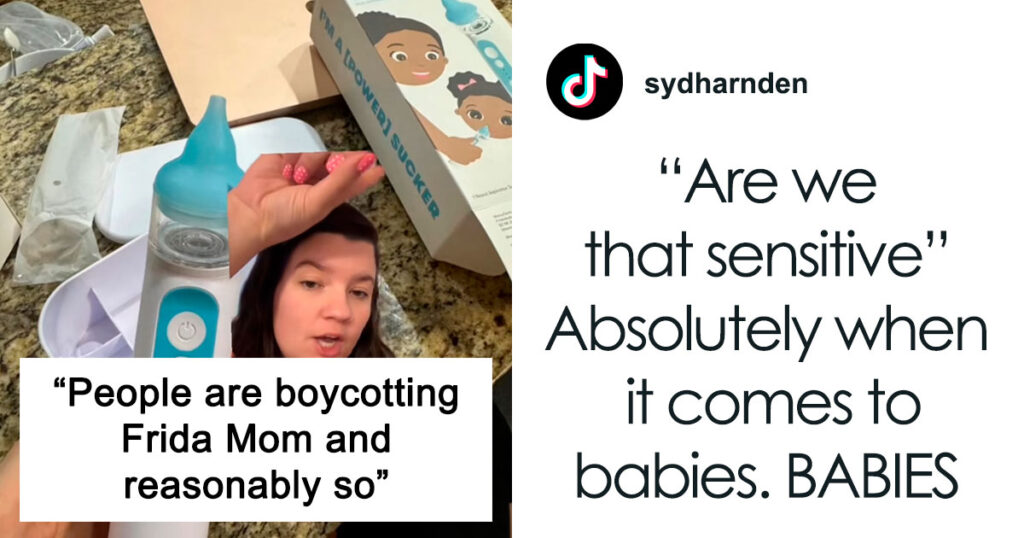
“Are You Mad Yet?”: Baby Product Company Goes Viral For Its Highly Inappropriate Marketing Slogans, Parents Boycott

Your reputation as a company is one of the most vital things ever. If you lose your customers’ trust, you can tank the entire enterprise. And there are some things that you simply don’t do if you want to stay in business. Baby care brand ‘Frida’ is currently mired in controversy. The internet is outraged after seeing the type of inappropriate, suggestive language the company used in its marketing. And some consumers are demanding a boycott. Scroll down for the full story and to see what the internet is saying. Some customers are calling out a well-known baby care brand for its use of adult, inappropriate, suggestive language in its marketing Woman discussing Frida Mom products amid controversy over inappropriate marketing causing online backlash. Image credits: truecrimetalkwithsam Here is the situation People boycotting Frida Mom over highly inappropriate marketing causing major online chaos and backlash since 2020. Hand holding Frida Mom electric nose suction device with packaging on kitchen counter, woman explaining product. Image credits: truecrimetalkwithsam Text excerpt discussing a currently available electric nose sucker and its marketing criticized in Frida Mom chaos online. Product packaging for Frida Mom thermometer with an overlaid image of a woman, highlighting controversial marketing online. Image credits: truecrimetalkwithsam Screenshot of a forehead thermometer box with inappropriate marketing text causing Frida Mom online chaos. Woman demonstrating Frida Mom product with instructions, highlighting controversial and inappropriate marketing causing online chaos. Image credits: truecrimetalkwithsam ADVERTISEMENT Text describing a controversial online post about Frida Mom’s marketing causing major chaos and inappropriate reactions. Screenshot of Frida Mom product called FridaBalls with marketing causing major chaos online over inappropriate advertising. Image credits: truecrimetalkwithsam Screenshot of text discussing inappropriate marketing by Frida Mom referring to protecting family jewels. Text excerpt discussing deleted or AI-generated content and people calling out Frida Mom marketing controversies online. Instagram post from Frida Mom marketing a 3-in-1 Nose Nail Ear Picker causing major online chaos. Image credits: truecrimetalkwithsam Text description explaining a small nose picker used to remove boogers, highlighting Frida Mom’s controversial marketing approach. Woman reviewing a 3-in-1 thermometer in a video, highlighting Frida Mom’s controversial marketing online. Image credits: truecrimetalkwithsam Text showing a controversial social media post linked to Frida Mom’s inappropriate marketing, sparking major online chaos. Woman making a hand gesture in a social media post highlighting Frida Mom’s controversial marketing and online chaos. Image credits: truecrimetalkwithsam Text excerpt discussing controversial marketing with mentions of a child’s face and inappropriate Frida Mom campaign causing chaos online. Image credits: truecrimetalkwithsam Other customers called the brand out as well Hand holding Frida Mom gas relief product in store aisle with text about inappropriate marketing controversy. Hand holding a Frida Mom product box with the text How About A Quickie in a store aisle with medical devices. Frida Mom product packaging showing inappropriate marketing wording for baby care tool in store shelf display. Image credits: thedorseyss Screenshot of Frida Mom social media post with cartoon family in bed, highlighting inappropriate marketing causing online chaos. Frida Mom product packaging on store shelf showing thermometer with questionable marketing phrase causing online chaos. Frida Mom marketing chaos with baby thermometer packaging showing a rectal thermometer and baby illustration. Woman reacting to Frida Mom thermometer marketing causing major chaos online for its inappropriate approach. Woman with a frustrated expression in a casual setting highlighting emotions related to Frida Mom marketing controversy online. Image credits: kyliexo413 Family of four outdoors, parents embracing and comforting children, highlighting Frida Mom marketing controversy. Image credits: Hoi An and Da Nang Photographer / Unsplash (not the actual photo) A spokesperson for the company put out a statement about the controversy ‘Frida’ has been accused of having used adult, suggestive, inappropriate language to advertise its baby care products in the past. Some parents were so outraged by what they saw that they vowed to boycott the brand and also return its products. Some people were so furious with what they saw that they called out the brand and its products on TikTok, with some clips garnering millions of views and making the news spread even further. As reported by The Telegraph, ‘Frida’ products are stocked in major United States shops, such as Target and Walmart. What’s more, this brand’s products are also sold on Amazon. Following the outrage, The Telegraph states that ‘Frida’ took down a part of its website with the names of the key executives working there. Here’s the statement that a spokesperson for ‘Frida’ gave to The Telegraph: “From the very beginning, Frida has used humour to talk about the real, raw and messy parts of parenting that too often go unspoken. We do this because parenting can be isolating and overwhelming, and sometimes a moment of levity is what makes a hard experience feel human, shared and survivable.” They continued: “Our products are designed for babies, but our voice has always been written for the adults caring for them. Our intention has consistently been to make awkward and difficult experiences feel lighter, more honest and less isolating for parents. That said, humour is personal. What’s funny to one parent can feel like too much to another. We’re never trying to offend, push boundaries for shock value, or make anyone uncomfortable. Importantly, our tone is never separate from our product.” According to the company representative, the humor they use is “always grounded in a specific feature, benefit or innovation – a reflection of the real problem we are solving for families. Frida was built to support families through some of the most vulnerable and transformative chapters of their lives. We stand firmly behind that mission.” They added: “We will continue to show up with honesty, empathy and courage. With each decision we make, we will continue to evaluate how we express our voice so that our commitment to families is unmistakable and our tone always meets the moment.” What do you think of the controversy? Have you ever used this brand’s products before? Have you yourself come across inappropriate language used in

Uncategorized

Explaining The FridaBaby Controversy: Babycare Brand Underfire, Accused Of Sexuallized Marketing

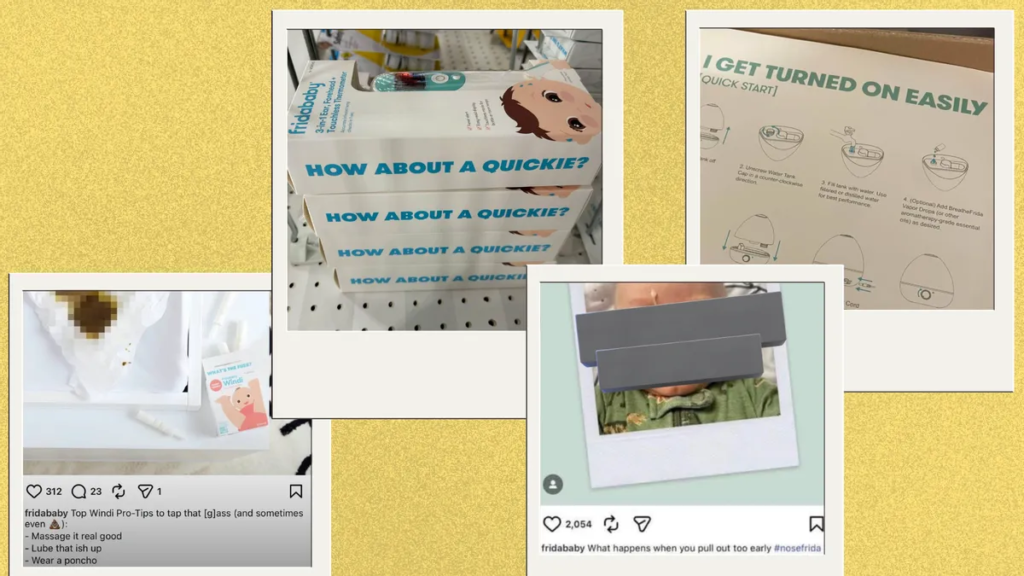
Some parents are raising issues against babycare brand FridaBaby, saying the product is being sexualized. Countless people have been calling out the brand for its use of inappropriate language to market the products. FridaBaby is accused of sexualizing baby products One post from a concerned person on social media showed a disturbing image on the brand’s 3-in-1 True Temp thermometer. Syracuse.com reported that the image on the product shows a thermometer next to an infant’s bare bottom with a caption that reads, “This is the closest your husband’s gonna get to a threesome.” There’s also a photo of the brand’s 3-in-1 Ear, Forehead + Touchless Thermometer that reads “How about a quickie?” Another image of the FridaBaby humidifier has a line that reads, “I get turned on easily.” A fourth photo shows a FridaBaby box that reads, “I’m a [power] sucker.” The social media user who posted that image, however, didn’t clarify what was inside that specific box. As more parents became concerned with the brand, people started to resurface other troubling images FridaBaby used in the past. According to Syracruse.com, one post from 2020, which is now deleted, showed an inappropriate caption next to a photo of a baby with a runny nose: “What happens when you pull out too early #nosefrida #dontmove.” Parents are calling for a boycott of FridaBaby Lila Rose, president and founder of Live Action (an anti-abortion nonprofit organization) slammed FridaBaby. “Unbelievably sick @fridababy sexualizing babies. Boycott!” she wrote on X. Unbelievably sick@fridababy sexualizing babies Boycott! https://t.co/4N2zYudQcU — Lila Rose (@LilaGraceRose) February 13, 2026 Many others are also calling for a boycott of FridaBaby: “Aside from their innuendos written on the side of their packaging, ‘Just a quickie’ and ‘I’m a [Power] sucker’, these type of statements are disturbing and the company needs to be banished,” one person wrote on , per the New York Post. “I hope you will do your part in boycotting this company and reporting them on all social platforms.” Some social media users, who are not parents, also expressed their concern. “I’m a man with no kids, but even I thought that was a bizarre way to market your products,” one man wrote on social media, according to the New York Post. There are some folks, however, who don’t see an issue with FridaBaby. “I love the product packaging (can’t speak to the ads). Here’s why: When you have a baby, so much of your identity gets absorbed into caregiving…Those jokes feel like a wink to the adult version of myself – like I didn’t completely disappear into motherhood,” one person said. How FridaBaby is responding to the backlash Initially, FridaBaby didn’t appear to have any plans on changing its marketing strategy. Instead, the company is doubling down on its controversy. For instance, FridaBaby’s Instagram post on Wednesday shows people embracing breasts at Mardi Gras. “This Mardi Gras, Frida is switching it up,” the company wrote in part. “Instead of objectifying boobs, what if we celebrated them? Because boobs aren’t the problem. Pretending they only exist for one reason (our entertainment) is.” Some social media users said they noticed how the company is hiding negative comments across its platforms. The company’s website is also showing an error message on its team page. KOMO News reported that FridaBaby was founded by CEO Chelsea Hirschhorn in 2014 while she aimed to bring the Swedish nasal product NoseFrida to the U.S. If you scroll their page the amount of accounts that are “no longer available” that commented on or shared stuff is very disturbing. — Shannon SOS (@princessshay013) February 13, 2026 However, in a statement provided to Blavity, the brand stated, “From the very beginning, Frida has used humor to talk about the real, raw, and messy parts of parenting that too often go unspoken. We do this because parenting can be isolating and overwhelming, and sometimes a moment of levity is what makes a hard experience feel human, shared, and survivable. Our products are designed for babies, but our voice has always been written for the adults caring for them. Our intention has consistently been to make awkward and difficult experiences feel lighter, more honest, and less isolating for parents. That said, humor is personal. What’s funny to one parent can feel like too much to another. We’re never trying to offend, push boundaries for shock value, or make anyone uncomfortable. Importantly, our tone is never separate from our product. The humor we use is always grounded in a specific feature, benefit, or innovation — a reflection of the real problem we are solving for families. Frida was built to support families through some of the most vulnerable and transformative chapters of their lives. We stand firmly behind that mission. We will continue to show up with honesty, empathy, and courage. With each decision we make, we will continue to evaluate how we express our voice so that our commitment to families is unmistakable and our tone always meets the moment.” Source link

Uncategorized

Frida Baby used sexual innuendo in its marketing. It sparked an uproar

Claim: Frida Baby, a company that makes products for baby, birth and postpartum care, used sexual innuendo in its marketing, both in its social media posts and on its packaging. Rating: What’s True The company printed suggestive phrases on the packaging of at least three of its products and in one social media post from 2020, which it has since deleted. However … What’s Undetermined … Snopes could not confirm that two of the alleged posts were real. Neither Google searches nor a search of the company’s Instagram feed showed the posts, which circulated only in screenshot form as of this writing. In February 2026, a rumor spread widely that Frida Baby, a company that makes products for babies and postpartum care, used sexual innuendo in its marketing, leading a number of social media users to express their outrage. For example, an X post shared several images of Frida’s alleged Instagram posts and packaging (archived): sexual jokes to market baby products is actually sick and twisted @fridababy this is absolutely appalling and disgusting The images showed: A purported screenshot of an Instagram post promoting a “3-in-1” thermometer with the caption “This is the closest your husband’s gonna get to a threesome,” referring to a sexual practice that includes three people.  A supposed box for another touchless thermometer with the phrase “How about a quickie,” a common phrase for rapid sexual intercourse.  An alleged step-by-step “quick start” manual for a humidifier titled “I get turned on easily” — a phrase that can both mean “switched on” and “aroused.” A box with the phrase “I’m a [power] sucker,” which evoked a term widely used in gay circles, “power bottom,” in which the “bottom” is the person who receives during sexual intercourse, but does so in an active, dominant way. “Sucker” may mean a person who gives oral sex. Frida makes devices that suck mucus from babies’ noses. In another post (archived), the same user included the an apparent screenshot of a July 5, 2021, Instagram post promoting a device that helps relieve babies’ gas-induced intestinal pain, also known as colic. The device, Windi, is a short tubelike tool one introduces into a baby’s anus to let out gas. The alleged caption read: Top Windi Pro-Tips to tap that [g]a** (and sometimes even [excrement emoji]): – Massage it real good – Lube that ish up – Wear a poncho (“Tap that a**” is a vulgar phrase for having sex. “Ish” reverses the sound from the expletive “s***.”) Another screenshot in the same post showed a purported Instagram post with the caption “What happens when you pull out too early,” evoking the ineffective “pullout” method of contraception. The photograph showed a baby with a trail of mucus across its face.  The X user also linked to the supposed Frida “Team” page and shared screenshots of the profiles (archived) of company employees who may have been responsible for the posts and packaging. The images showed portraits of three men, who worked as director of packaging, vice president of marketing strategy and production manager for package design. While Snopes could not verify all alleged Instagram posts, we confirmed Frida has used sexual innuendo in its marketing since at least 2020. For this reason, we rate the claim a mixture of true and undetermined information. In an emailed statement, Frida said its marketing strategy was meant to expose the messiest parts of parenting young children, and that it tried to inject some humor to help parents feel less alone: From the very beginning, Frida has used humor to talk about the real, raw, and messy parts of parenting that too often go unspoken. We do this because parenting can be isolating and overwhelming, and sometimes a moment of levity is what makes a hard experience feel human, shared, and survivable. Our products are designed for babies, but our voice has always been written for the adults caring for them. Our intention has consistently been to make awkward and difficult experiences feel lighter, more honest, and less isolating for parents. We’re never trying to offend, push boundaries for shock value, or make anyone uncomfortable. The statement did not address whether the company had shared, then deleted, the posts Snopes could not find. Sexual innuendo as a marketing strategy Snopes determined Frida had used sexual innuendo as a marketing strategy since at least 2020.  A Google search for the phrase “This is the closest your husband’s gonna get to a threesome” led to a Nov. 17, 2020, Facebook post by the company: (Google) The link led to a Facebook page that read “this video is no longer available.” The URL showed that the link led to a post by the official Frida Baby page on Facebook, however. This indicated the video for the 3-in-1 rectal thermometer and its caption were real.  Several searches confirmed that the box for the touchless thermometer included the reference to a “quickie.” We identified it in an Instagram reel shared by Frida on Dec. 23, 2025 (archived): (Instagram users @Fridababy and @Fridamom) Several e-commerce websites and one “unboxing” video from December 2024 confirmed the box for the electric nose-sucker included the phrase “[power] sucker:” The electric nose-sucker also was for sale on the Frida website. Unboxing videos on YouTube from October 2022 and March 2020 showed the “quick start” guide on the cardboard box of the Frida humidifier included the phrase “I get turned on easily”: (YouTube channel Crystal Had a Little Home) This product was no longer for sale on the Frida website as the company had updated the model, but it was available on other e-commerce websites. We could not find the Instagram posts with the photograph of the baby or the Windi tool. Neither Google searches nor a search of the company’s Instagram feed showed the posts, which circulated only in screenshot form as of this writing. However, users posted multiple screenshots of the post with the baby’s face that had slight differences, including both light and dark modes, and

Uncategorized

Adrien Brody’s multimillion‑dollar TurboTax Super Bowl ad: Why Intuit spends more on marketing than R&D

Super Bowl LX was just the latest evidence that when it comes to marketing, Intuit punches way above its weight. The financial software company’s charming commercial stars a comically overwrought Adrien Brody being calmed by a TurboTax “expert” who assures him that there’s no need for drama or crying when you use its products and services for tax filing. The company—also known for QuickBooks and other financial technology products and No. 258 on the Fortune 500—clearly spared no expense on its annual Super Bowl commercial. Intuit won’t say how much that 45-second ad cost, but the going rate just for the airtime was $8 million to $10 million for 30 seconds, and Brody, a two-time Oscar winner, presumably doesn’t work for the actors’ union scale.   It’s a signal of how important marketing is at Intuit. More broadly, “selling and marketing” is generally the largest expenditure in Intuit’s financial statements—larger even than research and development. The formula seems to work well: Intuit was founded in 1983 yet  still increases revenue by double digits almost every year. As for that SuperBowl spot? It was a hit: Of the 66 commercials shown in the game, Intuit’s was one of only nine given an “A” by the Kellogg School of Management’s annual Super Bowl advertising review panel. Fortune talked recently with Intuit Chief Marketing Officer Thomas Ranese about AI, story-telling, the NFL, and more. This interview has been edited and condensed for clarity. What’s the best way to market technology? With technology, I do believe that in some ways humanity, creativity, insights, empathy become more precious. The companies and brands that can show up with that are the ones that can stand out. I’m not sure that story was told in a lot of the AI ads that were running on the Super Bowl, but our story—ironically as a tech company investing in AI—was all about the [human] experts [who can help customers] and make taxes drama-free. Intuit’s Chief Marketing Officer, Thomas Ranese.Courtesy of Intuit Intuit has invested a lot in the NFL. In 2019 it became “the official financial and accounting software sponsor of the NFL,” which means companies that compete with important Intuit products can’t advertise in NFL games. Why NFL? When people are tuning in real time, that’s when they’re most engaged, and there is no greater arena than the NFL. It’s true of live sports generally, which is why we’re partners with the NFL and now are sponsors of Los Angeles 2028 and the USA team with the Olympics. For us, it’s two of the biggest stages in the world for engaging with people in real time and being part of the culture. Plus, our athletes, whether they’re football players or Olympians, are all about success and achieving their dreams, and that’s what we’re about—we’re about prosperity. In 2020, Intuit CEO Sasan Goodarzi jumped into AI with both feet. How do you use it in marketing? I think any honest CMO will tell you it’s a journey that we’re all on together, and no one has really cracked this yet. If they say they have, I don’t believe them. One of our best successes has been building an agentic team called the Marketing Studio to roll out in product campaigns end to end. It used to take a team of five or six groups coming together over three or four weeks to figure out, who are we targeting? What’s the message? How do we build the creative assets? Where do we place them? How do we optimize the analytics? We now have a team of AI agents that play all of those roles and within two hours can optimize campaigns. We’re seeing better conversion rates as a result. How about other uses of AI? For us, a lot of AI is, for example, that we can get you paid five days faster as a small business owner. That means a lot. Or we can get your tax refund five days sooner. That’s often someone’s biggest paycheck of the year. That’s the benefit of AI. It’s not some bell and whistle. What’s the best part of your job? Telling the customer story. That’s why I think marketers do what they do—the passion for storytelling, but telling the story of the customer, because it’s all about their success. Source link

Uncategorized

Why creative, not bidding, is limiting PPC performance

For a long time, PPC performance conversations inside agencies have centered on bidding – manual versus automated, Target CPA versus Maximize Conversions, incrementality debates, budget pacing and efficiency thresholds. But in 2026, that focus is increasingly misplaced. Across Google Ads, Meta Ads, and other major platforms, bidding has largely been solved by automation.  What’s now holding performance back in most accounts isn’t how bids are set, but the quality, volume, and diversity of creative being fed into those systems. Recent platform updates, particularly Meta’s Andromeda system, make this shift impossible to ignore. Bidding has been commoditized by automation Most advertisers today are using broadly similar bidding frameworks. Google Smart Bidding uses real-time signals across device, location, behavior, and intent that humans can’t practically manage at scale. Meta’s delivery system works in much the same way, optimizing toward predicted outcomes rather than static audience definitions. In practice, this means most advertisers are now competing with broadly the same optimization engines. Google has been clear that Smart Bidding evaluates millions of contextual signals per auction to optimize toward conversion outcomes. Meta has likewise stated that its ad system prioritizes predicted action rates and ad quality over manual bid manipulation. The implication is simple. If most advertisers are using the same optimization engines, bidding is no longer a sustainable competitive advantage. It’s table stakes. What differentiates performance now is what you give those algorithms to work with – and the most influential input is creative. Andromeda makes creative a delivery gate Meta’s Andromeda update is the clearest evidence yet that creative is no longer just a performance lever. It’s now a delivery prerequisite. This matters because it changes what gets shown, not just what performs best once shown. Meta published a technical deep dive explaining Andromeda, its next-generation ads retrieval and ranking system, which fundamentally changes how ads are selected. Instead of evaluating every eligible ad equally, Meta now filters and ranks ads earlier in the process using AI models trained heavily on creative signals, improving ad quality by more than 8% while increasing retrieval efficiency. What this means in practice is critical for marketers. Ads that don’t generate strong engagement signals may never meaningfully enter the auction, regardless of targeting, budget, or bid strategy. If your creative doesn’t perform, the platform doesn’t just charge you more. It limits your reach altogether. Dig deeper: Inside Meta’s AI-driven advertising system: How Andromeda and GEM work together Meta has repeatedly stated that creative quality is one of the strongest drivers of auction outcomes. In its own advertiser guidance, Meta highlights creative as a core factor in delivery efficiency and cost control. Independent analysis has reached the same conclusion. A widely cited Meta partnered study showed that campaigns using a higher volume of creative variants saw a 34% reduction in cost per acquisition, despite lower impression volume. The reason is straightforward. More creative gives the system more signals. More signals improve matching. Better matching improves outcomes. Andromeda accelerates this effect by learning faster and filtering harder. This is why many advertisers are experiencing plateaus even with stable bidding and budgets. Their creative inputs are not keeping pace with the system’s learning requirements. Your customers search everywhere. Make sure your brand shows up. The SEO toolkit you know, plus the AI visibility data you need. Start Free Trial Get started with Google Ads is quietly making the same shift While Google has not branded its changes as dramatically as Meta, the direction is the same. Performance Max, Demand Gen, Responsive Search Ads, and YouTube Shorts all rely heavily on creative assets to unlock inventory. Google has explicitly stated that asset quality and diversity influence campaign performance. Accounts with limited creative assets consistently underperform those with strong asset coverage, even when bidding strategies and budgets are otherwise identical. Google has reinforced this by introducing creative-focused tools such as Asset Studio and Performance Max experiments that allow advertisers to test creative variants directly. As with Meta, the algorithm can only optimize what it is given. Strong creative expands reach and efficiency. Weak creative constrains both. Dig deeper: A quiet Google Ads setting could change your creative The plateau problem agencies keep hitting Many agencies are seeing the same pattern across accounts. Performance improves after structural fixes or bidding changes. Then it flattens. Scaling spend leads to diminishing returns. The instinct is often to revisit bids or efficiency targets. But in most cases, the real constraint is creative fatigue. Audiences have seen the same hooks, visuals, and messages too many times. Engagement drops. Estimated action rates fall. Delivery becomes more expensive. This isn’t a platform issue. It’s a creative cadence issue. Creative testing is the missing optimization lever in mature accounts. Get the newsletter search marketers rely on. The agency bottleneck: Creative production Most agencies are structurally set up to optimize bids, budgets, and structure faster than they can produce new creative. Creative takes time. It requires strategy, copy, design, video, approvals, and iteration. Many retainers still treat creative as a one-off or an add-on rather than a core performance input. The result is predictable. Accounts are technically sound but creatively starved. If your account has had the same core ads running for three months or more, performance is almost certainly being limited by creative volume, not optimization skill. High-performing accounts today look messy on the surface with dozens of ads, multiple hooks, frequent refreshes, and constant testing. That isn’t inefficiency. That’s how modern PPC works. Creative testing is a process, not a campaign One of the biggest mistakes agencies make is treating creative testing as episodic. Launch new ads. Wait four weeks. Review results. Declare winners and losers. That approach is too slow for how fast platforms learn and audiences fatigue. High-performing teams treat creative like a product roadmap. There’s always something new in development. Always something learning. Always something being retired. Effective creative testing focuses on one variable at a time: hook, opening line, visual style, offer framing, social proof, or call to action. It’s not about

Uncategorized

What creatives can learn from the Frida Baby controversy

The Friday Baby controversy is the story of great branding that crossed a line. From its initial launch with a Swedish NoseFrida nasal aspirator back in 2014 to its expansion into fertility products and postpartum kits, the Friday Baby brand maintained a fresh tone of voice that ditched tired euphemisms to empathise with the raw realities of parenting. That often involved using humour, recognising that parenting can be dirty and tiring, and that laughing about that can provide relief. The brand also took a stance and called out hypocritical social norms. Most recently, it’s been pointing out female breasts are flaunted in billboards, music videos and social media, but cause outrage when seen doing their job of feeding a baby. That’s not the big Frida Baby controversy though. The outrage that exploded in the past week was over packaging designs and old social medias posts that featured sexual innuendos that were resurfaced in a post on X that was seen millions of time. You may like The post included a screenshot of a Friday Baby TikTok post with the caption “This is the closest your husband’s gonna get to a threesome” alongside a photo of a 3-in-1 rectal thermometer. Another photo shows packaging of the Frida Baby 3-in-1 Eat, Forehead and Touchless Thermometer with a phrase that reads “How About A Quickie?”. A humidifier is sold with the phrase “I Get Turned On Easily” and a social media post from 2020 showed a baby with nose discharge alongside the caption “What Happens When You Pull Out Too Early”. The captions and slogans were clearly intended to offer lighthearted relief to stressed-out parents, but the juxtaposition of sexual innuendos with products designed for infants crossed a line for many. Within hours there were posts on parenting forums calling for boycotts of Friday Baby products. men being the brains behind this nasty marketing unfortunately tracks. @fridababy you have some sick and twisted people on your team pic.twitter.com/EE0Eo3eUFfFebruary 12, 2026 Frida Baby’s reaction didn’t help. The didn’t initially issue a formal response, but it apparently began to delete old social media posts. It also removed the “meet the team” page from its website. It’s perhaps surprising that the controversy is only surfacing now because of a couple of viral social media posts many years after some of the offending branding was used. That suggests that those calling for boycotts products probably weren’t buying Frida Baby products anyway, or at least not when the brand used the controversial packaging slogans. Sign up to Creative Bloq’s daily newsletter, which brings you the latest news and inspiration from the worlds of art, design and technology. The brand eventually issued a statement in which it said: “From the very beginning, Frida has used humor to talk about the real, raw, and messy parts of parenting that too often go unspoken. We do this because parenting can be isolating and overwhelming, and sometimes a moment of levity is what makes a hard experience feel human, shared, and survivable. “Our products are designed for babies, but our voice has always been written for the adults caring for them. Our intention has consistently been to make awkward and difficult experiences feel lighter, more honest, and less isolating for parents. “That said, humor is personal. What’s funny to one parent can feel like too much to another. We’re never trying to offend, push boundaries for shock value, or make anyone uncomfortable. Importantly, our tone is never separate from our product. The humor we use is always grounded in a specific feature, benefit, or innovation — a reflection of the real problem we are solving for families. You may like “Frida was built to support families through some of the most vulnerable and transformative chapters of their lives. We stand firmly behind that mission. We will continue to show up with honesty, empathy, and courage. “With each decision we make, we will continue to evaluate how we express our voice so that our commitment to families is unmistakable and our tone always meets the moment. What we can learn from the Friday Baby backlash There’s been a trend for brands to adopt more informal, ‘cheeky’ or ‘sassy’ tones of voice to grab attention online, particularly among younger audiences. From Ryan Air’s chaotic self-deprecation to DuoLingo’s unhinged mischief and Oatly’s grating quirky self-awareness. some have had great success, with their content picking up engagement. Frida Baby showed that an honest directness can break through taboos and connect with consumers. But it’s discovered that there are some big lines in the sand. Not every joke that might work among friends is going to be well received as a mass market brand message. Context is important, and it should have been obvious that these juxtapositions would cause repulsion among many consumers. Today, that can spread like wildfire on social media. Brands can change as they grow. If posts no longer reflect what the brand is, delete them before they get called out; not after. Have a plan. A brand should be aware when its risking controversy and know what it’s going to do if there’s a backlash. Hastily deleting content isn’t great. If you’re not prepared to stand it, why was it there in the first place? Playful and witty banter can resonate with Gen Z and Millennials, who value humor and relatability over formality. It can humanise a brand and generate buzz and engagement. Frida Baby’s branding was a breath of fresh air, but taking it too far showed a lack of awareness of its product’s context and has risked detracting from the worthwhile conversations it was starting. Source link

Scroll to Top
0

Subtotal